This post contains affiliate links. As an Amazon Associate, I earn from qualifying purchases. Your price is not affected. Affiliate & advertising disclosure →
광고
It was March when my son Laurent asked me the question out of nowhere. We were leaving daycare, and he pointed at a storefront sign: “Mom, what does that say?” Until that moment, I hadn’t really thought about teaching him to read. Honestly, I’d been more focused on choosing organic groceries than planning his early literacy. But when he asked, something clicked—I realized the time had come.
I asked other moms what they did, and they all seemed to pick one route: workbooks, book sets, or teaching at home. I ended up trying all three over six months. And here’s what I learned: only one of them worked for us. The other two? They weren’t a fit for our family.
When Laurent Started Showing Interest in Letters
At first, I wasn’t sure if he was even ready. Experts say most kids aren’t developmentally prepared until around age four, so I figured Laurent’s timing was about right. The requests kept coming. A few days after asking about that sign, he wanted to write his own name. Then he started pointing at captions on his favorite shows, trying to sound them out.
He was sending me signals—clear ones. And I didn’t want to miss them. So I decided to try everything: I signed up for a workbook trial, looked into book series, and even made alphabet cards at home.
What I’ve learned is that every child shows interest in reading at their own pace. Some kids are hunting for letters at four; others don’t care until they’re past six. The timeline doesn’t really matter. What matters is watching for your child’s cues. When they start pointing at signs, asking to write their name, or tracing letters in books with their finger—that’s the signal that they’re ready.
The Workbook Route: Great Teacher, Wrong Fit
We started with a tutoring service where a teacher came to our house once a week for 30 minutes. Friends had raved about it—their kids loved the one-on-one attention. Laurent seemed into it at first. The teacher would use stickers, sing songs, and make it feel like play.
But by week three, something shifted. After the teacher left, Laurent had worksheets to finish on his own. And suddenly, he started treating those pages like homework—not play. One afternoon he asked me, “Do I have to do this today, Mom?” My heart sank. Reading had stopped being fun and become an obligation.
We stuck with it for about six weeks, then I asked Laurent if he’d rather stop. He nodded immediately. The workbook program itself isn’t bad—it’s just not for us. Some kids thrive on a structured routine and clear progression. But Laurent? He needs freedom to play and explore at his own pace.
Looking back, I think workbooks are perfect for certain kids. If your child likes scheduled appointments and following along with a curriculum in order, they might be great. But if your kid’s a free spirit who learns best through play, workbooks can feel like pressure rather than fun.
The Book Set: Beautiful, but Picked by Mom, Not by Him
After we quit the workbook program, I bought a phonics book series I’d read good reviews about online. It was a 48-book set, which felt like a serious investment. Laurent was excited when the huge box arrived—new books! But excitement faded quickly.
The books came in levels. There was this unspoken rule that you had to start with book one. Laurent wanted to jump to book five, and I found myself saying no—we had to follow the order. That’s when it hit me: these books weren’t his choice. I’d searched them out, decided they were good, and bought them. He had no say in it.
I felt bad about that. These books just became one more thing in his bookshelf instead of a tool that actually sparked his curiosity.
If you’re thinking about a book series, my advice is this: take your child to a bookstore first. Let them pick through books and say “I like this one.” Let them choose at least some of the set you buy. Trust me, what looks great to a parent and what excites a five-year-old are two totally different things.
Natural Exposure: The Method That Actually Stuck
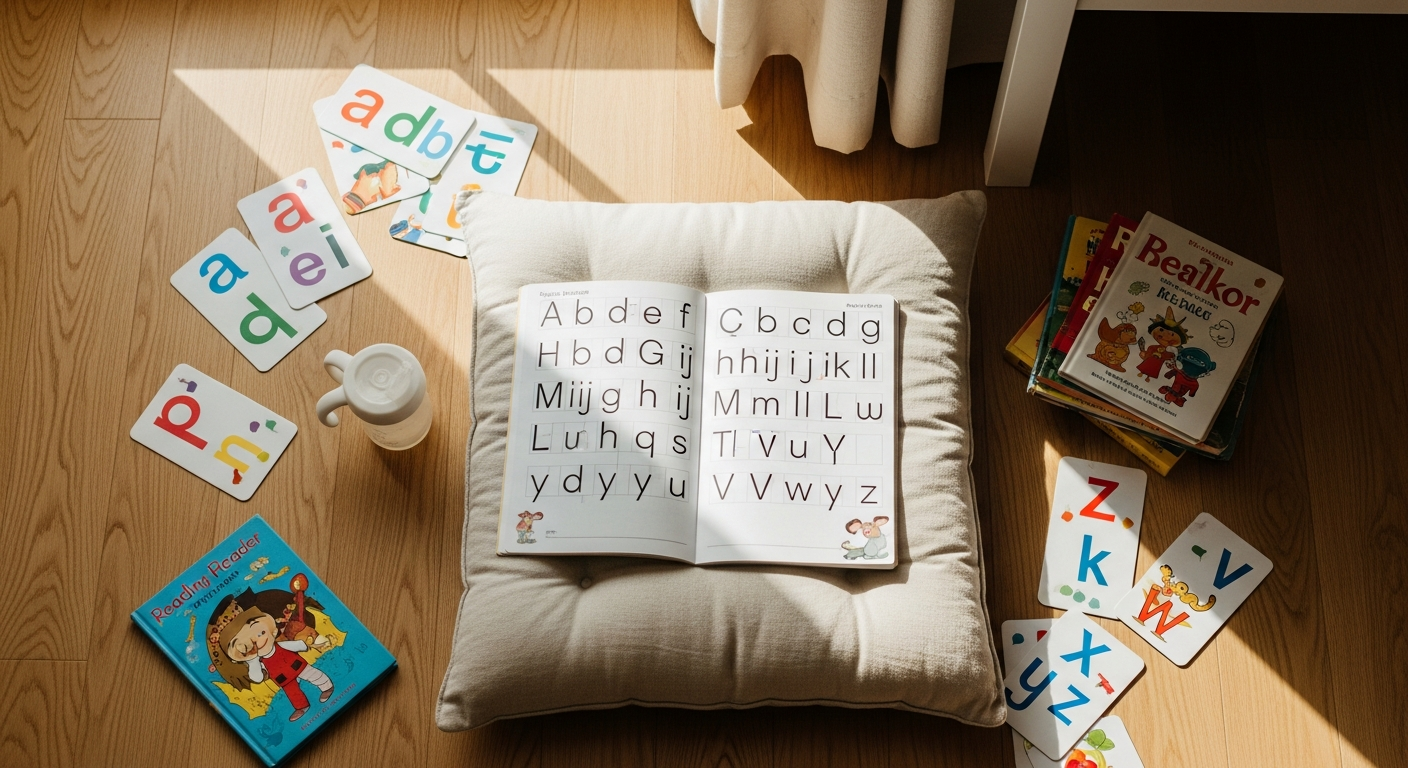
After the workbook and the book set didn’t work out, I tried something different. No structure. No program. Just everyday moments: reading signs when we’re out, pointing at letters in picture books, playing with alphabet fridge magnets when he felt like it.
I’d name letters he saw on storefronts, trace my finger under words as I read to him, and leave alphabet magnets on the fridge so he could play with them whenever. Nothing forced.
What amazed me was that Laurent never once complained. He didn’t ask if he had to do it. There was no resistance because it didn’t feel like learning—it felt like hanging out withh meom and noticing things. He’d ask questions, I’d answer, and we’d move on. No pressure, no worksheet, no rules.
Six months later, Laurent recognized almost every letter and could read simple words without help. Was it faster than the workbook approach would’ve been? Maybe not. But here’s what matters: he started thinking of letters as something fun, not something he had to do.
Here’s what natural exposure actually looked like in our house. In the bathroom, I’d use a whiteboard marker on the mirror during bath time. He’d write “ABC,” I’d write “DEF” next to it, and we’d just play. At the grocery store, I’d ask him to find the milk by reading the label. At first he’d look at the picture, but eventually he started recognizing the “M” sound. On our walks, we’d play a game: “Let’s find all the signs that start with ‘C’ today.” Every one he spotted made him so proud.
광고
Getting Started Without a Curriculum
If natural exposure sounds right but you’re not sure where to start, here are the things that actually worked for us.
Start with his name. Laurent learned his own three letters first because they mattered to him. We’d write his name on drawings, stick labels on his things, sign birthday cards together. It’s personal and motivating in a way random letters just aren’t.
Then move to characters he loves. Laurent is obsessed with a cartoon penguin, so we spelled out “P-O-P-O” with the fridge magnets. Then he noticed the “P” in his name matched the “P” in the penguin’s name. Suddenly he understood that letters combine—and that was his “aha moment,” not something a workbook taught him.
The sign-spotting game was huge for us too. On the way to school, I’d say, “Let’s find all the words that start with ‘G’ today.” When he spotted one, he’d get this incredible sense of accomplishment. Reading became a treasure hunt, not a task.
And we read the same books over and over. By the tenth time through, Laurent had memorized chunks of text. Then I could point at words and ask, “What’s this one?” He’d remember from the story and suddenly he was connecting sounds to letters without any formal instruction.
The Moment Everything Made Sense
Last week, Laurent picked up a picture book and started reading it to himself. His voice was slow and a little shaky, and he stumbled on some words. But he made it all the way through. When he finished, he looked up at me and said, “Mom, I can read books now.”
I got a little emotional hearing that. Because he didn’t learn from a teacher or a workbook—he learned while we were just living our lives together. And now he genuinely believed in himself. That matters more than how fast he learned.
If you’re wondering whether to buy a workbook set or enroll in a program, here’s my honest take: let your child ask first. When they show interest, skip straight to the method that fits them best. From what we’ve learned, that’s the one that lasts.
Questions I Keep Getting Asked
Q: When should I teach punctuation and consonant blends?
Laurent still doesn’t have consonant blends down perfectly. Once the basic letter sounds clicked, the rest seemed to follow naturally. I’m not pushing punctuation yet—right now we’re focused on reading, not writing. I figure that can come later without pressure.
Q: How much time did you spend on this each day?
We didn’t set aside specific time. When Laurent wanted to play with letters, we’d do it for five or ten minutes. Some days we’d spend fifteen minutes at the fridge making words. Other days we wouldn’t touch it at all. The key was never forcing him to sit down and “practice.”
Q: Should he learn his native language first before starting English?
This really depends on your family. Laurent showed interest in letters first, so we went with that. I wasn’t in a rush to add English on top. Every family’s different—some do both at once, others wait. Pick what feels right for your kid and your stress level.
Q: Won’t he just learn to read in school anyway?
He absolutely will. But Laurent asked first, so we went with his lead. The point wasn’t to get him reading before his peers—it was to help him feel curious and capable, not forced. If your kid isn’t asking, there’s no rush. School will take care of it.
What’s Left in Our House After Six Months
The workbook subscription got cancelled. The book set is still on the shelf, and Laurent reads from it sometimes, but it’s not special anymore. The thing we actually use every single day? Those alphabet magnets on the fridge. He’ll run over between bites of lunch, rearrange letters into words, and yell, “Dad, is this right?” When he’s wrong, he tries again. And it’s all his idea.
I’ve learned that speed isn’t the point. What matters is whether your child feels like letters are something to play with, not something to fear. You can’t force that feeling. But if you give them space and let them lead, they’ll reach for it themselves.
Next up, we’ll pick books he actually wants to read—and he’ll be the one choosing them, not me.
One last thing: the biggest win from these six months wasn’t crossing off a reading milestone. It was watching Laurent fall in love with books. Every night he still brings me a stack and says, “Can you read to me?” Knowing he sees reading as something fun, not something he has to do—that’s the real success.

DCT Family Guide · Laurent’s Mom · Last updated 2026-07-02
Hands-on reviews from a Korean mother of two.
Personal experience-based. Product, policy, and price details may change over time — verify with the source before purchase.