As an Amazon Associate, we earn from qualifying purchases. Your price is never affected. Full affiliate disclosure.
This post contains affiliate links. As an Amazon Associate, I earn from qualifying purchases. Your price is not affected.
광고
It was a Saturday morning in mid-May when my son Laurent wandered over to the bookshelf, rummaged around for a bit, and came back with a picture book. “Mom, can you read this one again?” The funny thing is, I hadn’t bought it to teach him reading at all. I’d just picked it because it looked fun. But from that day on, Laurent asked for that same book constantly.
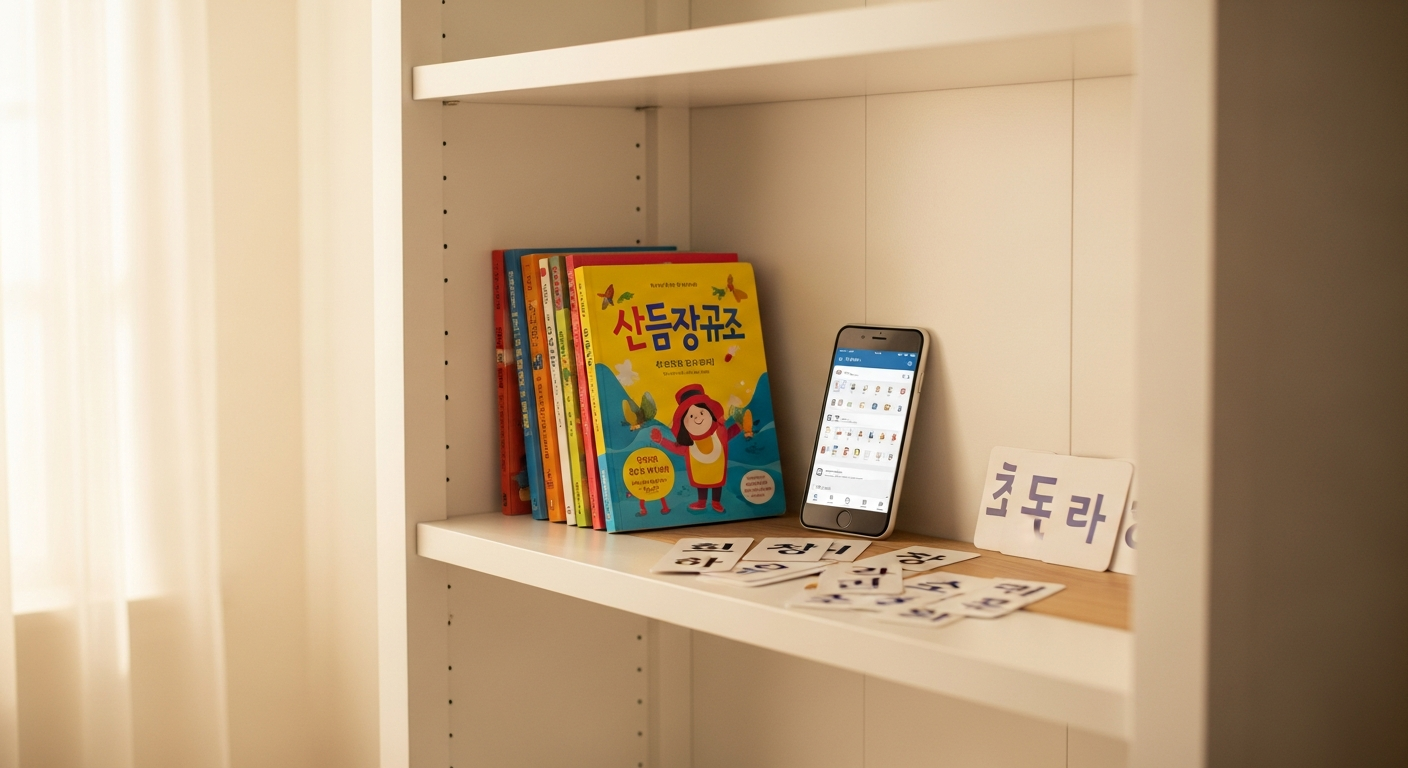
Three months earlier, when I decided to start teaching him to read Korean, I’d prepared three different tools: flashcards, an app, and picture books. I wasn’t sure which would work best. Honestly, I thought the app would be the most efficient—it uses AI to match his level and create personalized lessons, right? But after three months, there was only one thing Laurent kept asking for on his own.
Every mom I know worries about the same thing at this age: “Should we be teaching reading yet?” “My neighbor’s kid already learned.” I get it. I really do. (And if I’m being honest, I fell into that trap when I started hearing talk at the preschool pickup line.)
The First Few Weeks, He Only Wanted the App
At the start, I downloaded a Korean reading app on a tablet—the kind with an AI tutor that diagnoses your child’s level and builds a custom curriculum. Laurent loved it the first week. He was so into it that he actually asked to play the “reading game” himself. The bright colors, the sounds, the instant feedback when he tapped—it was engaging, no question. We set a limit of 15 minutes a day, but he wanted more.
Then week two hit, and everything changed.
“Mom, I don’t want to do it today.” That’s when I noticed the shift. (Later, I figured out that he got bored with the same types of problems repeating.) The app was good at tracking progress, but it seemed to create pressure—like he *had* to get it right. When he got an answer wrong and the screen prompted him to try again, his whole face would shut down. “Mom, this is hard,” he’d say, pushing the tablet away. The problem with apps is you have to get the answer correct before you move forward. That might be great for learning, but for a five-year-old, it felt like stress.
Flashcards Were Exhausting for Me
At the same time, I started with flashcards—one of those character-themed sets with cute cartoon mascots. A hundred-card deck. My plan was to show him 10 cards a day and ask “What’s this?” It seemed straightforward enough.
The flashcards did have one advantage: they were physical. Laurent could touch them, shuffle them, play with them. But honestly? The work fell entirely on me. Every evening when he came home from preschool, I’d have to sit him down, lay out the cards, watch his reactions, and then gather them all back up and organize them again.
One day I was so tired that I suggested we skip it. “How about we take a break today?” He just shrugged. “Okay.” That’s when it clicked: he wasn’t doing this for him. He was doing it because I was making him.
There was another problem too—the logistics. When Laurent scattered the cards everywhere, I had to collect and reorganize them. More than once, I found cards wedged under the couch. A learning tool shouldn’t add stress to my day, and yet here it was, becoming just another thing on my to-do list instead of something enjoyable we did together.
But Picture Books? He Kept Asking for More
The picture book was different. I hadn’t chosen it with learning in mind at all—he picked it out at the bookstore because he liked the cover. But once I started reading it to him, he was hooked. “Mom, read it again.” He must have asked me to read that book fifty times in three months.
At first he just listened. Then one day, he started following along and reading parts himself. “Mom, look—that says ‘puppy,’” he’d say, pointing at the word. I later read that four- and five-year-olds learn best through picture books with engaging stories, and Laurent seemed to be proving that all on his own.
The magic of picture books is that they don’t *feel* like learning. He was just enjoying the story—and somewhere in that process, the words started sticking. With the app and cards, there was always this underlying pressure to perform. With the book, there was only curiosity: “What happens next?”
And here’s something I didn’t expect: he never got tired of reading the same book over and over. In fact, with each reading, he’d pick up more. At first, he’d just listen while I read “The rabbit hops away.” By the tenth time, he’d point to “hops” and ask, “That’s the hopping word, right?” Repetition became learning naturally, without it feeling forced.
Sitting with him on my lap, his head against my chest, asking me questions about the pictures—that was so different from holding flashcards across the table or watching him stare at a screen. It was *time together*, not a lesson.
광고
What Actually Changed After Three Months
Here’s what I discovered: of the three methods, picture books were the only one Laurent actually reached for on his own. The app? He’d only use it if I asked, “Want to do the reading game today?” “Oh, right,” he’d say vaguely. The flashcards? They’re sitting in a drawer now, untouched.
Picture books are different. He pulls them off the shelf himself. In the morning before school, after dinner, before bed—he asks me to read to him three or four times a day. And now? He’s started reading the simple sentences by himself.
Last week he came home from preschool beaming. “Mom, look! I can read!” His teacher had noticed and praised him. Seeing that confidence on his face made those three months of trial and error feel completely worth it.
But the real win wasn’t just that he learned to read. It’s that he *loves* reading now. Before, if I suggested a book, he’d say no. Now he asks, “Mom, can we get new books?” He went from resisting reading to seeking it out. That’s something no app or flashcard could have given him. Learning stuck because the experience was joyful.
| Method | Laurent’s Response | Mom’s Reality Check | After 3 Months |
|---|---|---|---|
| Reading App | Loved it for 2 weeks, then bored and frustrated | Nice progress tracking, but screen time worried me | Doesn’t reach for it |
| Flashcards | Liked handling them, but not the repetition | Draining—daily setup, cleanup, organization | Barely used |
| Picture Books | Asks for “one more” constantly | Quality time together, genuinely enjoyable | Pulls them off the shelf himself daily |
But Maybe Your Child Is Different
Here’s the thing—I know families where the app worked beautifully. Other kids who love flashcard games and learned to read that way. Laurent just happens to be the storytelling type. Every kid has their own learning style.
I think experimenting with a few approaches at the start makes sense. But the real test is this: does your child ask for it, or are you always the one who has to initiate? Does your kid reach for it willingly? That’s your answer right there.
For Laurent, it was picture books. So now I’ve put the app and cards away and I’m buying him new books every month. (I figure if I don’t flinch at the grocery bill, I shouldn’t flinch at book purchases either.)
How to Get Started, Depending on Your Child
Based on what I’ve learned, here are some practical tips if you’re starting out:
If your child struggles to sit still, an app or short video might work better than books. You can do five minutes at a time without asking for a long attention span. Just set a timer and stick to it—15 minutes max per day.
If your child is competitive, flashcard games could actually work. “Let’s see who can match more cards!” Some kids thrive on that. The trick is letting them win sometimes.
If your child loves stories, picture books are probably your answer. You don’t need to buy “reading curriculum” books right away. Pick books on topics he already loves, read them aloud, and naturally point out words. “What does this say?” Keep it casual.
If you’re short on time, two or three dedicated sessions a week are better than forced daily practice. A relaxed 30 minutes on the weekend beats 10 stressful minutes every evening. Consistency matters less than enjoyment.
What I Learned About Choosing Picture Books
After three months of buying books, I’ve figured out what works:
Font size matters. If the text is too small, kids lose interest. About 10 letters per line and 2–3 lines per page feels right. Laurent would actually say, “This one looks too hard,” when the text was crowded.
The illustration-to-text balance is crucial. Too much text and kids get overwhelmed. Too little and they’re not engaged. You want pictures that support the story without stealing the show.
Repetitive sentence structures are your friend. Books where the same pattern repeats—”The dog runs,” “The cat runs,” “The bird runs”—help kids recognize patterns and learn naturally. Laurent felt so proud when he’d predict the next word.
Pick topics your child already loves. Laurent’s obsessed with animals, so animal books hold his attention instantly. Whatever your kid lights up about—dinosaurs, trucks, nature—start there. Interest is everything.
I’m planning to share some of Laurent’s current favorite books next week. If you’re starting reading with a four- or five-year-old and want recommendations, drop a comment and let me know!

DCT Family Guide
Practical parenting for real life.
DCT Family Guide · Laurent’s Mom · Last updated 2026-07-01
Hands-on reviews from a Korean mother of two.
Personal experience-based. Product, policy, and price details may change over time — verify with the source before purchase.
💬 Frequently Asked Questions
❓ What age is best to start teaching a child to read Korean?
There’s no magic age, but around 5 is when many kids start showing interest in letters and sounds. The bigger question isn’t when, but how—focus on what keeps your child genuinely engaged rather than forcing it because other kids are learning.
❓ Why did the Korean reading app stop working after the first week?
The app was engaging at first with its colors and sounds, but it created pressure by forcing correct answers before moving forward. For a 5-year-old, getting stuck on wrong answers felt stressful rather than educational, which killed his motivation quickly.
❓ Are flashcards worth it for teaching young kids Korean, or are they too much work?
Flashcards can work because they’re physical and tactile, but they require a lot of parent effort—organizing, prompting, and cleaning up scattered cards. If your child isn’t self-motivated to use them, it becomes another chore for you rather than a natural learning moment.
❓ What made picture books more effective than apps or flashcards for teaching reading?
Picture books didn’t feel like lessons—they were just fun stories the child wanted to hear again and again. The repetition happened naturally through enjoyment rather than obligation, and there was no pressure to get answers right or complete tasks.