As an Amazon Associate, we earn from qualifying purchases. Your price is never affected. Full affiliate disclosure.
This post contains affiliate links. As an Amazon Associate, I earn from qualifying purchases. Your price is not affected. See our full disclosure
광고
It was a Friday evening in late February 2026 when my son Laurent came home from preschool and started flipping through a picture book. Suddenly, he pointed at a word and asked, “Mom, what’s this?” His finger landed on the Korean word for “cat,” but then he pointed to the word “cat” on the same page. In that moment, I found myself wondering: Is it okay to expose a five-year-old to English when he’s still working on Korean?
I’d heard conflicting advice from other parents. Some swore you had to master Korean first. Others insisted early exposure to both languages was better. Honestly, I didn’t know what was right for Laurent.
So I decided to find out for myself. For three months straight, I ran a side-by-side experiment with Korean and English, documenting everything: where his attention naturally went, whether he got confused, and what actually worked. Here’s what happened.
Why We Waited Until After Age 4
Most language experts recommend waiting until at least age 4 before introducing formal reading instruction. (Laurent was a bit older when we started.) I’d read enough about language development to know that his brain needed time to wire itself properly first. So I let go of the pressure and waited.
Laurent first showed real curiosity about Korean letters in his late fours or when he was almost five. During story time, he’d stopped just looking at pictures and started pointing at words. “Mom, what does this say?” became his favorite question. He wanted to write his own name. That’s when I knew he was ready, so I started making it a game.
Then he came home from preschool humming the ABC song and pointing at alphabet letters on book covers. “What’s this?” he’d ask. Suddenly I was weighing whether it was smart to introduce both languages at once. This is where the experiment began.

How I Structured the Three-Month Test
From the end of February through the end of May, I kept daily notes. We spent about 30 minutes a day on language—15 minutes on Korean, 15 minutes on English. (I started with 10 minutes each, but as I watched Laurent’s focus, I gradually added a few more minutes.)
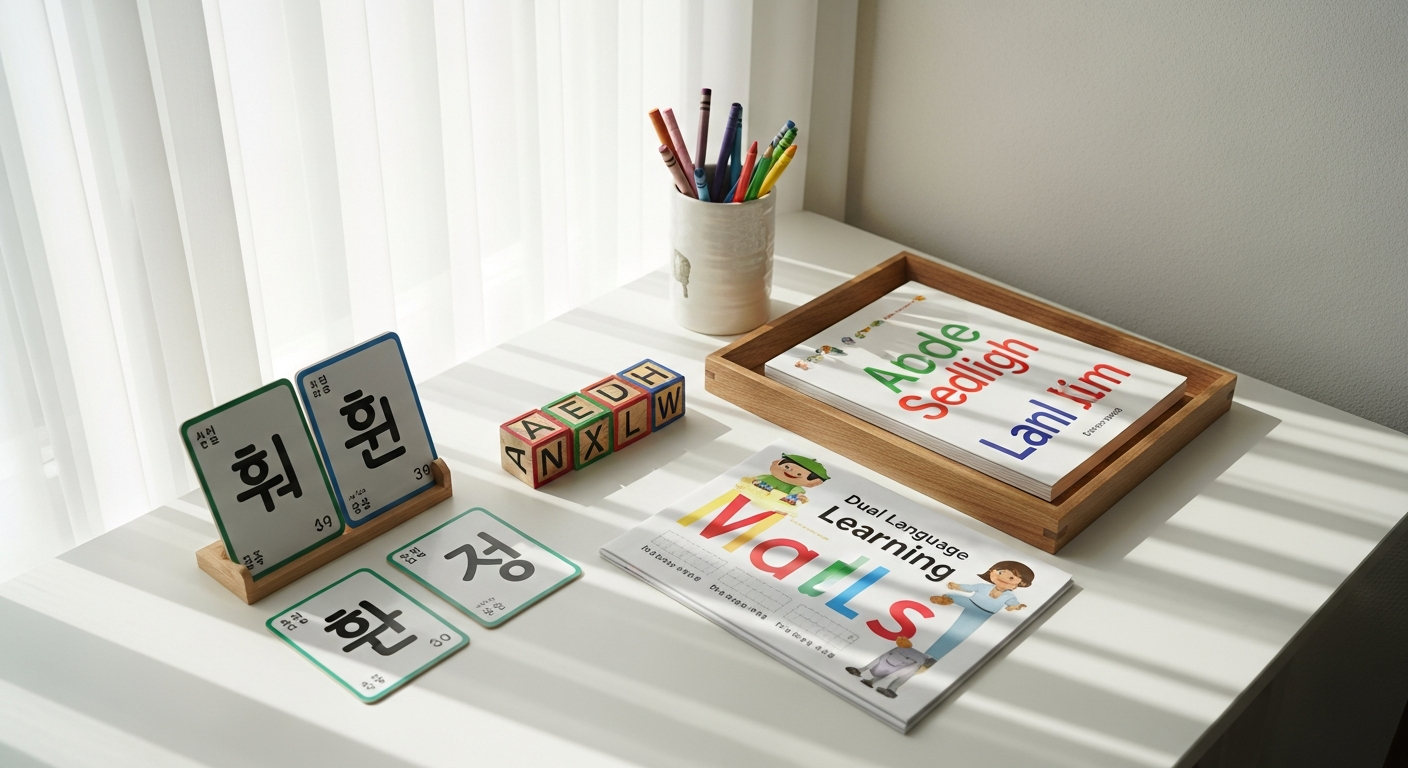
During Korean time, we’d play with word cards, read picture books together while pointing out letters, and do sticker activities with vowels and consonants. I’d read somewhere that pairing letters with meaningful stories in books was more effective than worksheets, so that became our main approach.
During English time, we’d spend about five minutes on a phonics app, then use the remaining ten minutes for English picture books or alphabet card games. Full transparency: my accent isn’t great, so I relied heavily on apps and audiobooks to model correct pronunciation.
The key thing I did differently was let Laurent choose what to do. I’d ask, “What should we start with today?” and he’d say either “Korean first!” or “Alphabet first!” Some days he only wanted to do Korean, so we’d spend the full thirty minutes on word cards.
The Focus Gap Was Huge
By the time I looked back at three months of notes, the pattern was crystal clear. When Laurent did Korean activities, he’d stay focused for 12 to 15 minutes. English? About 7 to 10 minutes. That’s nearly double the difference.
When he played with Korean word cards, he’d start asking his own questions: “Mom, if I put these two together, what happens?” He’d combine letters, make the word for “bag,” and beam with pride. But with English alphabet cards, he seemed to just be recognizing shapes. He knew what “A” looked like, but connecting it to “apple” took much longer.
One moment really stood out. Mid-April, Laurent came to me before bed and said, “Mom, I wrote ‘apple’ today!” (He meant the Korean word for apple.) His teacher had written it on the board, and he’d copied it. He was proud. With English, it was more like, “Sing the ABC song with me?” The emotional stakes felt completely different.
| Category | Korean | English |
|---|---|---|
| Average focus time | 12–15 min | 7–10 min |
| Times he asked to do it | 4–5 times/week | 1–2 times/week |
| How he learned | Sound + meaning | Shapes (memorizing) |
| Progress after 3 months | Reading simple two-syllable words | Recognizing capital letters |
광고
Did He Get Confused? Not Really
This was what I worried about most. Would mixing two languages scramble his brain? The honest answer: almost not at all.
Children can distinguish between a native language and a foreign language by age one, and introducing a foreign language before that can confuse native language development. But Laurent was already five—he clearly understood the difference between Korean and English.
Sometimes he’d ask, “Mom, is this Korean or English?” I’d explain, and he’d just accept it and move on. He never mixed the languages or started pronouncing things wrong. The two systems stayed separate in his head.
What I did notice was that Korean was becoming his primary language. He thought in Korean. He asked questions in Korean. English felt like a fun activity, not a real way to communicate. And honestly, at this age, I think that’s exactly how it should be.
What I Decided After Three Months
By late May, I’d made a decision: focus on Korean for now, and keep English as something light.
Watching Laurent discover reading was remarkable. He’d see a store sign and sound it out. He’d spot letters on a delivery box and call them out proudly. That sense of pride—of unlocking something real—mattered. English, at this point, was just the alphabet song and a few letter shapes. That was fine. I didn’t need to push harder.
I’d also read that to raise a truly bilingual child, you’d need to expose them to a language about 20 to 40 percent of the time—roughly 2 to 4 hours a day. In our house, that just wasn’t possible or realistic. And we didn’t need it to be.
One thing Laurent said at the end of May stuck with me: “Mom, I can read books by myself now.” That was the answer I needed. Reading and thinking in his mother language came first. English could wait.
What We’re Doing Now
Starting in June, I bumped up Korean time to 20 minutes a day. English dropped to just weekends—an alphabet song or a couple of picture books, nothing forced. Laurent seemed relieved. No pressure, no struggle, just play.
If a child seems ready, you can let them learn through play without worry, and pushing too early can actually damage the parent-child relationship. That resonated with me. Laurent will have plenty of time for English. Once he’s solid with Korean—probably around age seven—we’ll dive into proper phonics.
If you’re in the same boat, here’s what I’d say: watch your child carefully. Pay attention to where his focus naturally goes, what he asks for on his own, and where he feels proud. For Laurent, it was clear: Korean came first. Your child might be different.
Once Laurent masters reading in Korean, English is next on our agenda. We’re thinking formal phonics when he turns seven. I’ll write about how that goes when we get there.

DCT Family Guide · Laurent’s Mom · Updated June 29, 2026
Real stories from our family about language learning, bilingualism, preschool, and finding what actually works—not what sounds good in theory.
DCT Family Guide · Laurent’s Mom · Last updated 2026-06-29
Hands-on reviews from a Korean mother of two.
Personal experience-based. Product, policy, and price details may change over time — verify with the source before purchase.
💬 Frequently Asked Questions
❓ Should I wait until my child masters Korean before introducing English?
Based on my three-month experiment with Laurent, I found that introducing both around age 5 didn’t cause confusion as long as I kept sessions separate and structured. That said, every child is different—if your child seems overwhelmed or frustrated with one language, it’s perfectly fine to focus on that first and add the second language later.
❓ How long should each language session be for a 5-year-old?
I started with 10 minutes per language and gradually increased to 15 minutes as Laurent’s focus improved. The key is watching your child’s attention span—if they’re fidgeting or losing interest before the time is up, it’s better to end on a positive note than push through.
❓ Did your son mix up Korean and English letters during the learning process?
There were a few moments early on where he’d point at a Korean character and try to apply English phonics rules, but it didn’t last long. Keeping the sessions clearly separate (Korean time vs. English time) and using different materials for each language seemed to help his brain categorize them properly.
❓ What’s more effective for teaching Korean to young kids—apps and worksheets or picture books?
For Laurent, picture books with meaningful stories worked much better than worksheets because he could connect the letters to something he cared about. I did use word cards and sticker activities to make it interactive, but the stories gave him context and kept him engaged longer than drill-based activities.