As an Amazon Associate, we earn from qualifying purchases. Your price is never affected. Full affiliate disclosure.
This post contains affiliate links. As an Amazon Associate, I earn from qualifying purchases. Your price is not affected. Affiliate & Ad Disclosure
광고
Last Saturday afternoon, Laurent dumped a handful of number cards on the floor and said, “Mom, can we do this again?” We’d finished playing thirty minutes earlier. But that same morning, he’d ditched a workbook after five minutes with an “I have a tummy ache,” and bolted.
I was honestly stuck on how to introduce math to my 5-year-old. One mom swore by apps, his preschool teacher talked about workbooks, and every parenting blog seemed to champion board games. I had no idea which one actually worked. So I decided to test all three for three months straight. The difference was real.
There was one clear winner. The other two? He lost interest in five minutes flat.
Workbooks Got Boring After Three Pages
We started with a workbook from the bookstore—you know the type. Number tracing from 1 to 10, counting apples and circling the answer. Day one, he was excited and did two pages. Day two? He dropped the pencil and said his wrist hurt.
I realized pretty quickly that asking a 5-year-old to sit still with a pencil for that long is actually a lot to ask. Laurent’s the kind of kid who’d rather be outside running around than cooped up at a table. And honestly, ten minutes of stillness is solid focus at that age. But there was something else going on—he seemed anxious. “What if I get it wrong?” he’d ask. That surprised me, coming from a five-year-old.
Workbooks do have their perks. You can clearly see what you’ve covered, it’s easy to track his progress, and they’re cheap—about $6 to $9 each. The problem? For Laurent, it felt like school. We’d manage two or three pages a week before he’d refuse altogether.
Apps Meant Fighting Pop-Ups Instead of Learning
Next, we tried educational math apps. Everyone kept saying, “Kids these days all learn on tablets,” so I downloaded three free ones. Tap the number, hear a sound. Count the animals, earn stars. Complete a mission, unlock a character. You get the idea.
Laurent was glued to it at first. The second I handed him the tablet, his eyes lit up. But every five minutes, an ad would pop up. To unlock the next level, I had to confirm an in-app purchase. Laurent would get frustrated. “Mom, this won’t tap!” And I’d be sitting next to him, frantically swiping ads away.
On top of that, we’re trying to keep screen time minimal in our house. Our rule is tablets only for weekend movie nights. But once I started pulling out the tablet for math, Laurent started asking for YouTube. That wasn’t going to work.

I looked into paid versions, which run about $7 to $11 a month. No ads, sure, but he was still glued to a screen for longer stretches. The American Academy of Pediatrics recommends keeping digital time for young kids under 30 minutes a day. Using up his whole screen budget on math felt wasteful.
The Board Game Was Unstoppable
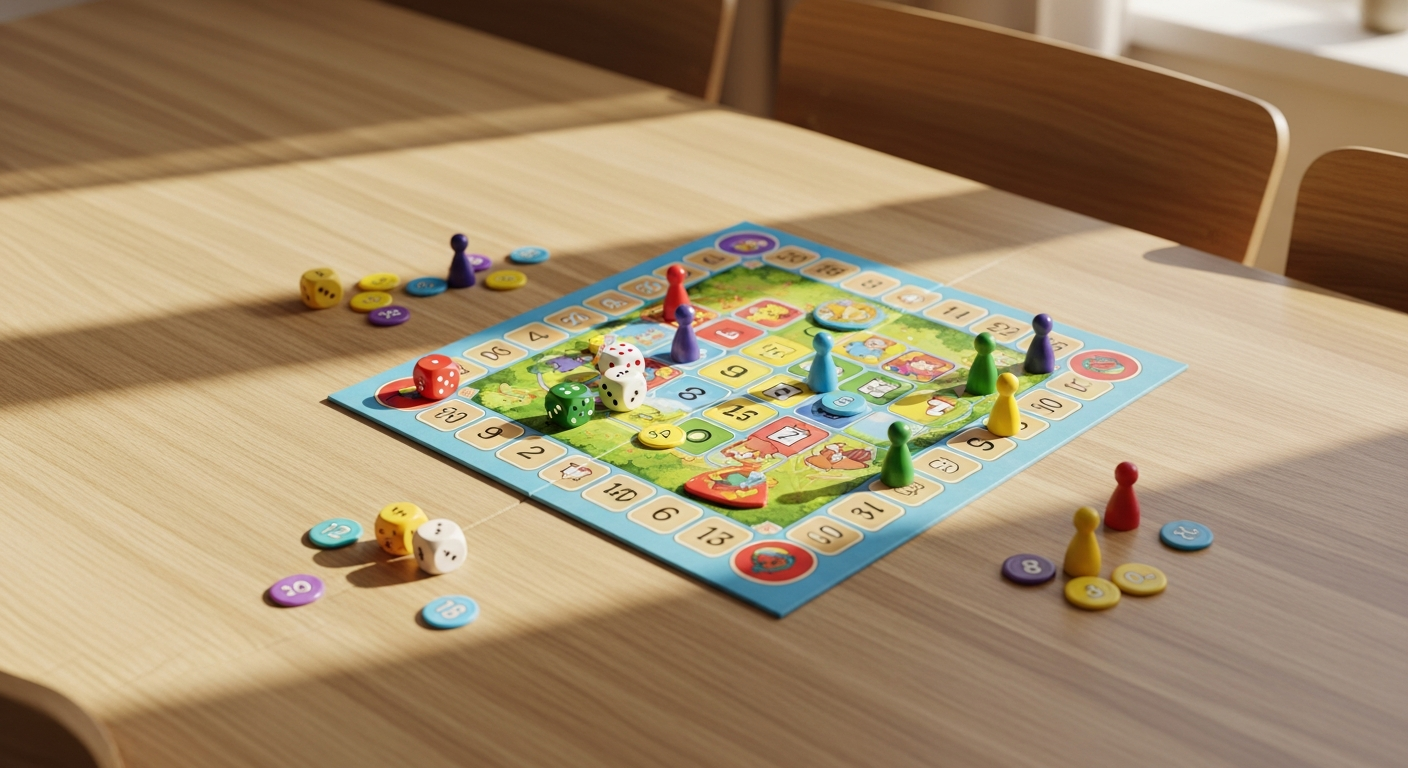
Last on the list was the Orchard Game—you roll a dice and pick fruit from the board before a crow steals the harvest. A friend’s mom swore her kid would play it for hours, so I grabbed one for around $20, half-skeptical.
It wasn’t a fluke. A week in, Laurent was asking to play every single evening. Once he started, he’d sit with it for 20 to 30 minutes straight. Remember thee kid who couldn’t manage five minutes with a workbook and checked out of the app after ten? This was a different child entirely. His focus quadrupled.
I think I figured out why: it felt like play, not work. “Counting” wasn’t the goal—winning was. He’d roll the die, move his token, grab the fruit, laugh, call out the numbers without being asked. He was moving things, making decisions, seeing the results immediately. There was no “right or wrong answer” hovering over him.
And the math just… happened. He’d look at the dice and say “Three!” then count “one, two, three” as he reached for fruit. At first, he’d skip numbers—”one, two, five!”—but after a month, he was counting in the right order naturally. I never corrected him once. The game did that work for me.
Now we rotate between Halli Galli Junior (matching sets of five and ringing a bell) and Number Swamp (which introduces simple addition and subtraction—probably better for age 6). Halli Galli’s been great for faster counting. Number Swamp feels like a nice next step once his birthday hits.
광고
Here’s How They Actually Compare
After three months of real-world testing, here’s what I learned:
| Tool | Time He’d Stay Focused | Cost | Best For |
|---|---|---|---|
| Workbook | Under 5 min | $6–9 per book | Kids who are comfortable holding a pencil and sitting quietly for work |
| Math App | Around 10 min | $7–11/month (paid) | Parents who don’t mind extra screen time and need something portable for car trips |
| Board Game | 20–30 min | $15–30 (one-time) | Active kids who love movement, and families who can carve out a few minutes together |
For Laurent, the answer was crystal clear: board games. He’d ask to play on his own. The other two? I had to ask him to try them. With the workbook, he’d dodge it. With the app, he’d get restless once the ads kicked in.
Learning Happened Without Him Realizing It
About three months in, Laurent was eating a snack and casually said, “Mom, I have five crackers.” Just like that. Before board games, he’d count everything as “one, two… lots!” Now he could actually count. His preschool teacher mentioned it too: “He’s counting things more accurately lately.” I hadn’t done a thing except play a board game with him most evenings.
That’s what I think matters most at this age. He didn’t know he was learning math. He was just having fun. No pressure to get the right answer, no badges or levels to chase, no anxiety about performing. Just… rolling a die, moving a token, laughing. The counting came naturally.
I know some parents worry: “Isn’t board games a ton of work for me?” Honestly, the first couple of weeks are. But after that, he got the hang of it. Now he even sets up the game himself and plays with his stuffed animals, talking through each turn. I just stand nearby doing dishes, offering the occasional “Nice four!” The heavy lifting is done.
What Comes Next
Right now we’re sticking with games that build counting skills. Once he turns 6, I’m planning to move toward games that introduce simple addition and subtraction. I know it’s not a one-size-fits-all answer—some kids genuinely do love pencil work, and some families need the flexibility of apps. But if you’ve got a kid like mine who lights up when he’s moving, choosing, and playing? Board games might just be your secret weapon.

DCT Family Guide · Laurent’s Mom · Last updated 2026-06-28
Hands-on reviews from a Korean mother of two.
Personal experience-based. Product, policy, and price details may change over time — verify with the source before purchase.
💬 Frequently Asked Questions
❓ How long should a 5-year-old be able to focus on math activities?
Most 5-year-olds can focus for about 5 to 10 minutes on structured activities like workbooks before needing a break. Board games tend to hold attention much longer—around 20 to 30 minutes—because they involve movement, interaction, and don’t feel like traditional schoolwork.
❓ Are free math apps actually effective for kindergarten-age kids?
Free apps often come with constant pop-ups, ads, and interruptions that break a child’s focus and turn learning time into a battle with the screen. While the educational content might be decent, the distractions usually outweigh the benefits for young kids who are easily pulled off-task.
❓ Why do board games work better than workbooks for teaching math to preschoolers?
Board games don’t feel like school—they’re social, hands-on, and let kids move around instead of sitting still with a pencil. Kids also don’t worry about ‘getting it wrong’ the same way, so there’s less performance anxiety and more natural repetition of math concepts through play.
❓ Can you really measure a child’s focus improvement with different learning methods?
Yes, by tracking how long your child voluntarily engages with an activity before asking to stop or getting distracted. In this case, the difference was clear: 5 minutes with workbooks and apps versus 20-30 minutes with board games, plus the child asking to play again afterward.