This post contains affiliate links. As an Amazon Associate, I earn from qualifying purchases. Your price is not affected. Affiliate & Ad Disclosure
Quick Summary
- BPA-free silicone spoons and suction bowls are must-haves for starting solids
- Look for a spoon head about ¾ inch (2 cm) wide to match your baby’s mouth
- Check if the set is dishwasher-safe and can handle boiling water (at least 248°F/120°C)
- Go with darker silicone colors—bright pinks and pastels stain easily
- Budget: single spoons run $6–$12; complete sets range from $18–$40
Last Saturday morning, I started my second baby on solids at 6 months. I pulled out the spoon set I’d used with my older daughter, and it looked huge. She could barely get half of it in her mouth before pushing it back out. So by that afternoon, I’d already ordered three new spoons.
When it comes to feeding gear, safety is everything. Choosing BPA-free feeding utensils is how you protect your baby’s health. The FDA banned BPA in infant feeding products back in 2019, so most new products are safe—but it’s still worth double-checking before you buy.
Today I’m walking you through five feeding sets I’ve actually used with my kids. Here’s what worked, what didn’t, and what I’d buy again.
Why I Ditched the Teaspoon After Day One

With my first baby, I used whatever teaspoon was in the drawer. Metal, obviously. Every time it touched her gums, she’d jolt. And it was way too big—barely a quarter of it fit in her mouth.
At this stage, the goal is just getting your baby used to eating from something other than a breast or bottle. It’s not about nutrition yet—it’s about the experience of using a spoon. That means you need something soft and small enough that she’ll actually accept it without resistance.
Babies are born with about 6 months’ worth of iron stores from their mothers, and that runs out right around the 6-month mark. That’s when you start introducing iron-rich foods like beef or chicken in small amounts to prevent anemia. But first, she has to be willing to take the spoon.
What I Look For in Baby Feeding Sets—Three Non-Negotiables
By the time I was buying my fifth set, I’d figured out what actually matters.
1. Material Safety
BPA-free is table stakes. Look for soft, squishy silicone (similar to a teething toy) so it won’t irritate gums or developing teeth. Make sure it can handle boiling water for sterilizing—at least 248°F (120°C).
2. Spoon Size and Shape
For starting out, the spoon bowl should be about ¾ inch (2 cm) wide. My second baby had a particularly small mouth, so I grabbed a ⅝-inch (1.5 cm) option separately, and she did so much better with it. Get a handle that’s at least 6 inches (15 cm) long so you can reach the bottom of the bowl while feeding.
3. Easy Cleanup
Dishwasher-safe is genuinely a game-changer. Washing baby spoons by hand two or three times a day will destroy your wrists. Some silicone can warp in the dishwasher, so always read the fine print.
1. Moyuum Two-Stage Starter Spoon Set — Two Sizes, One Box

This was my second baby’s first spoon. You get two spoons—one sized for when she’s just starting, and a slightly larger one for a few weeks in.
The smaller spoon is about ¾ inch (1.8 cm) wide—perfect for a 6-month-old’s mouth. Around month two of solids, you can swap in the larger spoon (⅞ inch / 2.2 cm). It comes with a little carrying case, which is genuinely handy when you’re on the go.
But here’s the real talk: the color staining is real. I had the bright pink set, and after feeding sweet potato and squash, I ended up with permanent yellow marks. I scrubbed, soaked, nothing worked. That’s why I ordered a gray set as backup.
What I loved: Two-size progression, case included, dishwasher-safe
What I didn’t: Bright colors stain badly
Price range: Around $9–$12
Best for: First-time solids parents, lots of outings
2. Jellycat Suction Bowl + Spoon Set — Complete Starter Kit
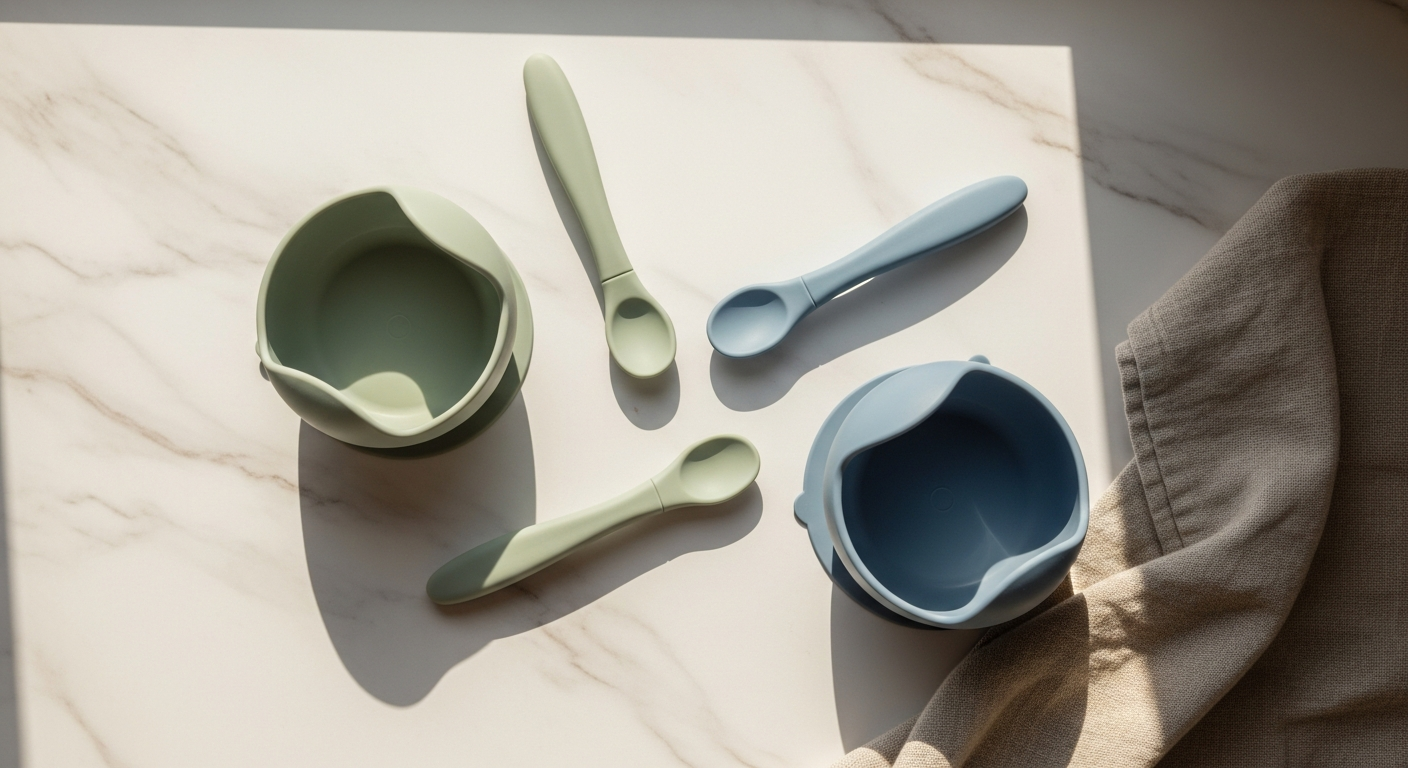
I used this set with my first baby, and it’s my go-to recommendation for anyone building a solids starter kit from scratch. Bowl and spoon together means you’re ready to feed.
The suction bowl has a seal on the bottom that sticks firmly to the table. When my baby started grabbing at her dish around 7 months, nothing moved. Not once. I would’ve had food all over the floor with a regular bowl.
The spoon handle is 6 inches long and reaches deep into the bowl easily. The silicone is soft enough that she can chew on it without discomfort.
The catch? Suction really only works well on wood tables. We have a glass-top table, and while it held at first, by week four the seal had weakened. I could restore it by washing and drying thoroughly, but that got old fast.
What I loved: Bowl + spoon combo, strong suction, BPA-free certified
What I didn’t: Suction can weaken on glass or marble tables
Price range: Around $18–$24
Best for: Wood table owners, one-purchase setup
3. OXO Tot Silicone Freezer Cubes + Spoon Set — Batch Prep Hero

This one’s different. You get two storage cubes for freezing portions plus two spoons—a whole system.
I’m a batch-cooking person. Every Sunday I make five days of purees and freeze them. The 6-cavity cubes are perfect for that: portion out 2 tablespoons per cube, freeze solid, pop them out into a bag. When it’s time to eat, thaw one cube and go. Saves so much time during the week.
I keep one spoon at home and one at grandma’s house. The handle is a bit chunky, which is great for my grip but might be heavy for her to hold when she’s older and wanting to feed herself.
The value is solid too—those freezer cubes alone run almost $20 separately, so buying the set is worth it.
What I loved: Storage cubes included, dishwasher-safe, saves meal prep time
What I didn’t: Thicker handle might be too heavy for baby to self-feed later
Price range: Around $22–$28
Best for: Meal-prep parents, anyone who freezes baby food
4. Munchkin Self-Feeding Spoon and Fork Set — Save This for Month 2
This is less for starting solids and more for when baby wants to grab the spoon herself—usually around 7 or 8 months. The handle is short and thick, designed for chubby little hands.
By month two of solids, my baby started reaching for the spoon. So I let her hold this one while I fed with another—messy but necessary. The short grip meant she could actually manage it, and the soft silicone was safe even when she gnawed on it.
The fork end is rounded, not sharp, so no risk there. Comes with a cute case, so it travels well to daycare or family dinners.
Fair warning: the 3-inch handle won’t reach the bottom of your serving bowl when you’re feeding her, so save this for when she’s got her own plate and more developed solids routine.
What I loved: Baby-sized grip, fork included, case included
What I didn’t: Handle too short for parent feeding (use after month 2)
Price range: Around $14–$18
Best for: 7+ months, self-feeding practice
5. Mothercare Soft Silicone Spoon Set — Budget-Friendly Starter
If you want to dip your toes in without spending much, this is your answer. Two spoons and a case for under $10.
The silicone is especially soft—even squishier than some pricier options—which is ideal for a fresh 6-month-old. The spoons can handle boiling water (248°F/120°C), but the case can’t—wash and air-dry that one instead. That’s a minor annoyance given the price.
Colors come in mint, pink, and gray. Unless you’re okay with some discoloration over time, go with the gray.
What I loved: Ultra-soft silicone, price, two spoons included
What I didn’t: Case needs hand-washing only
Price range: Around $8–$11
Best for: Budget-conscious parents, trying solids for the first time
The Bottom Line
You don’t need fancy or expensive. You need safe, soft, and small. Pick a BPA-free silicone spoon with a narrow bowl (roughly ¾ inch / 2 cm wide) and a 6-inch handle, and you’re set. Whether you spend $8 or $30, that’s the foundation.
My honest advice? Start with the two-stage spoon set or the budget option. Once you see what matters to your family—suction bowl, freezer cubes, self-feeding handles—upgrade from there. And whatever color you choose, go dark. Your future self will thank you when there’s no orange ghost stain on a pink spoon.

DCT Family Guide · Laurent’s Mom · Last updated 2026-06-22
Hands-on reviews from a Korean mother of two.
Personal experience-based. Product, policy, and price details may change over time — verify with the source before purchase.
💬 Frequently Asked Questions
❓ Can I just use a regular teaspoon from my kitchen to start solids?
You can, but metal spoons are hard on sensitive gums and most kitchen teaspoons are too wide for a 6-month-old’s mouth. Soft silicone spoons about ¾ inch wide are designed to fit comfortably and won’t startle your baby when they bite down on it.
❓ Do suction bowls actually stay stuck to the table or high chair tray?
They work best on smooth, clean surfaces like plastic high chair trays—not so much on textured placemats or wood tables. That said, a determined baby can still pry them up, so suction bowls slow down the mess but don’t eliminate it entirely.
❓ Why do light-colored silicone spoons and bowls stain so easily?
Bright pinks, whites, and pastels absorb pigments from foods like sweet potato, carrot, and tomato-based purees. Darker colors like navy, gray, or sage hide staining much better and still look decent after months of use.
❓ How many spoons do I actually need when starting solids?
Start with at least 4–6 spoons so you always have clean ones ready between dishwasher runs. Babies often grab the spoon mid-feeding or you’ll drop one on the floor, so having backups on hand saves you from washing dishes three times a day.