As an Amazon Associate, we earn from qualifying purchases. Your price is never affected. Full affiliate disclosure.
This post contains affiliate links. As an Amazon Associate, I earn from qualifying purchases. Your price is not affected. View our full affiliate disclosure
광고
I still remember Laurent’s first day of solid foods. Soaking 10 grams of rice, grinding it, cooking it—the whole process took over an hour. I remember thinking, “If I’m doing this three times a day, when am I supposed to do anything else?”
Fast forward a few months, and a handful of smart kitchen tools cut that down to 30 minutes total. Today, I’m sharing the five appliances that actually lived up to the hype—tested in real life, not just Pinterest.
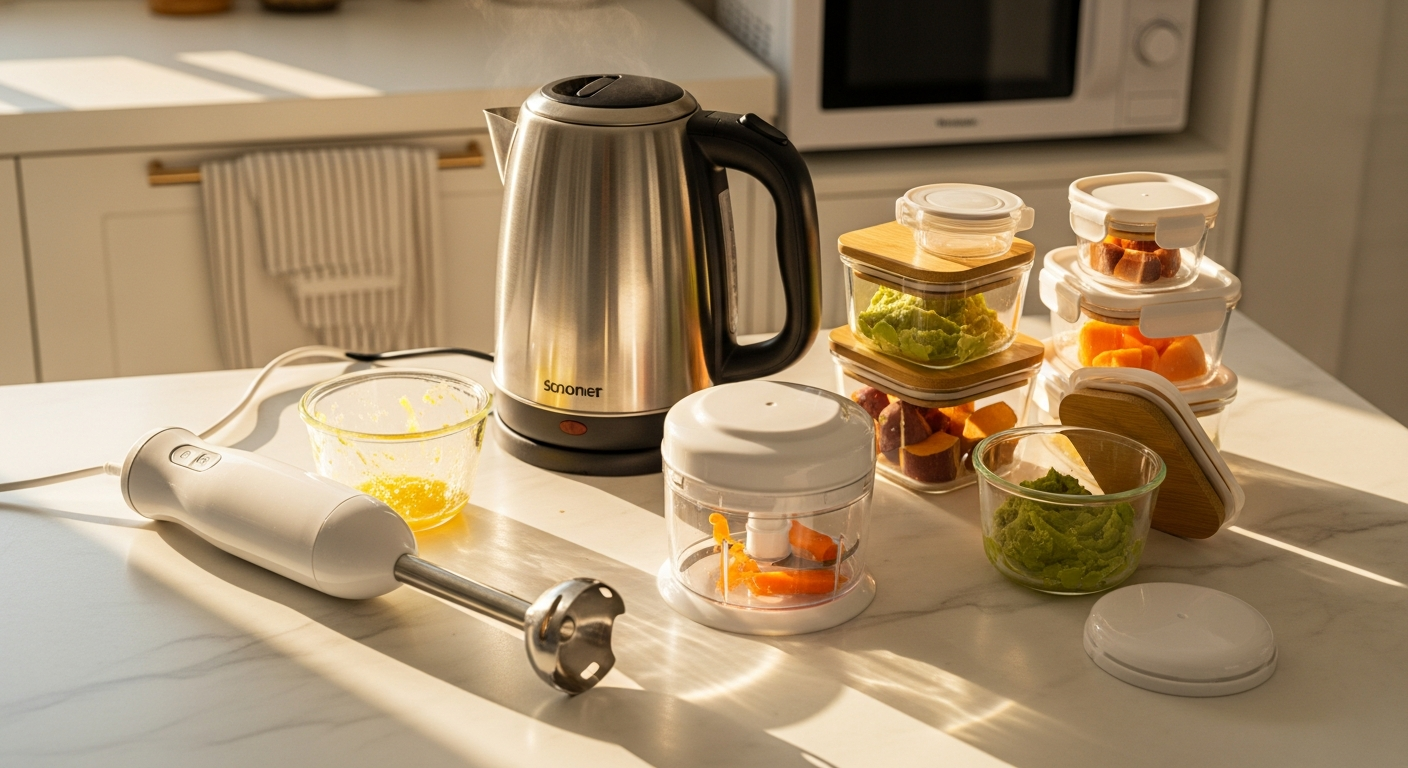
Hand Blender — The MVP for Smooth Purees
Early-stage baby food needs to be silky smooth. I tried a regular blender at first, but with small portions, the food just stuck to the sides and never blended properly.
A hand blender changes everything. You blend right in the pot—no transferring, no extra dishes. When I was making Laurent’s broccoli puree, I’d cook it, blend it straight in the pot, and push it through a fine-mesh sieve. Done.
Parent forums consistently rave about cordless hand blenders that include a mini food processor attachment. That’s when it really earns its space: you can transition seamlessly from purees to chopped food without buying another gadget. And honestly, I was skeptical at first, but the cleanup is surprisingly easy, and it takes up almost no cabinet space.
See Philips hand blenders on Amazon
Mini Food Chopper — Game Changer for the Middle Months
Once you move into stage two, you need texture—and this is where a small chopper becomes indispensable.
I noticed parents online doing something brilliant: they’d warm up a packet of microwaveable rice, toss it in the chopper with a splash of water, pulse it, and cook it. No soaking required. That alone saves 20 minutes per batch.
A good quality mini chopper handles dry ingredients like rice beautifully and produces that slightly chunky texture stage-two babies need. I also used it for portioning chicken—15 seconds in the chopper and you’ve got perfectly minced meat. What would’ve taken 10 minutes of knife work is done in seconds.
See Ninja mini choppers on Amazon
Microwave — Thawing Frozen Batches in Minutes, Not Hours
You’ll be making baby food in big batches and freezing it—that’s just how it works. But thawing can become a bottleneck.
Modern microwaves, especially newer LG models, come with dedicated defrost settings that are actually smart about it. I pop a frozen container in, set it, and in 2–3 minutes I have perfectly thawed, evenly heated food. The traditional water bath method? That’s 15 minutes, easy.
I was worried about microwave cooking destroying nutrients, but our pediatrician reassured me that quick reheating is completely fine. That peace of mind, plus the time saved during morning feedings when Laurent is crying and hungry, is absolutely worth it.
Freezer Storage Containers — Organization That Actually Saves Time
Here’s the truth nobody tells you: cooking baby food is only half the battle. Cooling it, portioning it, labeling it, and organizing it in the freezer—that’s another 30 minutes right there.
For early-stage food, silicone ice cube trays are brilliant. Pour in the puree, pop it in the freezer, done. Once you hit stage two, glass containers are better—they don’t stain or retain odors, and they feel more durable long-term.
The key is choosing containers that stack neatly. Our freezer is absolutely packed with baby food, but because the containers nest together, everything stays organized. Look for options with secure lids and clear sides so you can see what you’ve got without opening everything.
See freezer containers on Amazon
Electric Kettle — The Unsung Workhorse
You don’t think about this one at first, but boiling water is a constant need. You’re rinsing rice, cooking grains, adjusting consistency—you’re boiling water a lot.
An electric kettle brings 1 liter to a boil in about 3 minutes. On the stovetop? Nearly 10 minutes. That time adds up fast when you’re doing it multiple times a day.
I also used ours for formula prep. A kettle with temperature control is brilliant—set it to 70°F and you have water ready for mixing bottles anytime. Plus, the keep-warm function means hot water is always available when you need to adjust the consistency of a puree or clean a spoon quickly.
See electric kettles on Amazon
광고
What to Look for Before You Buy
Safety first: choose BPA-free products and confirm everything can handle boiling water sterilization. For tools with blades—blenders and choppers—detachable blades make cleanup infinitely easier.
Size matters too. Early-stage portions are tiny (30–50ml), so oversized equipment feels wasteful. Prioritize appliances designed for small-batch cooking.
And here’s something people don’t mention: noise. You’ll be making baby food during nap time. A loud blender has woken Laurent more than once at the worst moments. If quiet operation matters to your household, check reviews specifically for sound level.
| Appliance | Best For | Time Saved | Pro Tip |
|---|---|---|---|
| Hand Blender | Stages 1–2 | 15 min → 3 min | Blend straight in the pot |
| Mini Chopper | Stages 2–3 | 10 min → 10 sec | Works on meat and vegetables |
| Microwave | All stages | 15 min → 2 min | Perfect for thawing frozen batches |
| Freezer Containers | All stages | 30 min → 10 min | Silicone cubes early on, glass later |
| Electric Kettle | All stages | 10 min → 3 min | Get one with temperature control |
Frequently Asked Questions
Do I really need all five? No. Start with a hand blender and freezer containers—those are non-negotiable. Add the others based on your routine and budget.
What’s the best brand for each? Philips and Braun dominate hand blenders. Ninja leads mini choppers. For containers, Pyrex glass and OXO silicone are parents’ favorites. For kettles, Cuisinart and Hamilton Beach are reliable.
Can I use a regular blender instead? You can, but you’ll regret it. Full-size blenders are awkward with small portions and harder to clean. The hand blender is worth the separate purchase.
Is microwave baby food safe? Yes, according to pediatricians. Quick reheating doesn’t significantly damage nutrients. Just stir well to ensure even heating.
How much freezer space do I need? More than you think. Stackable containers help. Plan for at least one shelf dedicated to baby food during peak-prep weeks.

DCT Family Guide · Laurent’s Mom · Last updated 2026-06-18
Hands-on reviews from a Korean mother of two.
Personal experience-based. Product, policy, and price details may change over time — verify with the source before purchase.