광고
As an Amazon Associate, we earn from qualifying purchases. Your price is never affected. Full affiliate disclosure.
The Highlights
- My five-year-old, Doa, completed an entire figure-8 wooden train track layout on her own last weekend
- She didn’t give up when the trickiest connections stumped her—she kept trying until it clicked
- What I learned about fine motor skills and focus through an hour of wooden train play
- How a simple mesh pouch system turned cleanup time into a storage lesson
It was a Saturday morning, and Doa was sitting at our oval living room table. Wooden track pieces tumbled out of a green mesh pouch, and she held a red arch bridge in her hands, thinking hard. “Mom, how do these fit together?” she asked—then immediately started trying different pieces on her own without waiting for my answer.
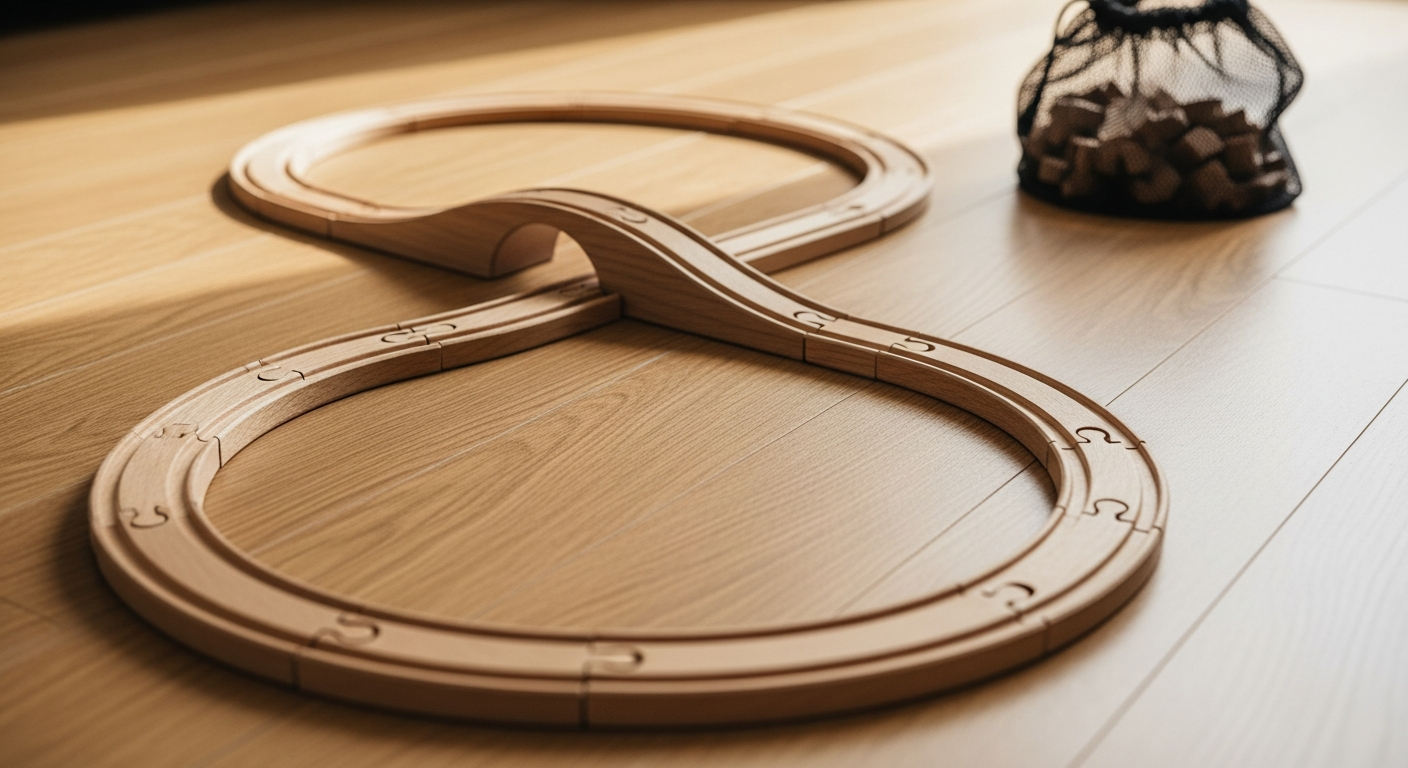
Building a figure-8 track is no small feat for a five-year-old. You have to alternate curved and straight rails, position the bridge supports just right so the train can pass underneath. For the first ten minutes, Doa kept inserting and removing the rail at the same spot over and over, problem-solving as she went.

The finished figure-8 layout, complete with the red triple arch, wooden block tower, and green wood figures positioned around the track
When Connections Were Hard, She Stayed With It
At one point, when a rail slot wouldn’t line up right, she got frustrated. “This won’t work!” she said, a little loud. When I asked, “Do you want help?” she shook her head and picked the rail back up. That’s when I made a quiet decision not to step in. I think it matters for kids to work through solving their own problems.
The arch bridge gave her the most trouble. It took about twenty minutes before she figured out how to thread the rails through the supports on both sides. The hand strength just wasn’t quite there yet—rails kept slipping out. But she didn’t quit. On her fifth try, we heard that satisfying click, and the rail locked in. Her face just lit up. “Mom, I did it!” That’s a moment I’ll remember.
Dinosaurs and Trees—Creating Her Own World
Once the track was done, Doa placed two green wooden evergreen figures next to the rails. Then she tucked a brown plastic dinosaur (a T-Rex) between the trees and started narrating to herself: “The dinosaur is waiting in the forest for the train.” I sat on the couch and watched this unfold.

Two green wooden trees and a brown dinosaur arranged next to the track
She rolled the wooden train cars (white, black, and orange) onto the track and pushed them gently so they glided under the arch bridge. Every time the train passed the dinosaur, she made a whooshing sound and created a little scene where the dino was chasing it. This is actually my favorite part of playtime. It’s when I see her inventing the story as she goes, making up rules inside her own imaginary world.
Building It Again—Inserting the Arch Bridge
Four days later, on Saturday afternoon, Doa pulled out the train set again. This time she decided to build it from scratch all by herself and laid out two green mesh pouches on either side of the table. The left one held all the track pieces; the right one had the trains, cars, and little signs sorted and ready.

Assembling the red arch bridge with organized storage pouches on either side
This time, Doa set up the arch bridge first. She remembered that part had been hard before and changed her strategy. Threading the rails underneath was so much smoother now. One satisfying click, and it was done. “This time I did it fast!” she said proudly.
광고
Wooden Blocks and Signals—Adding Her Own Details
On the left side of the track, she stacked natural wood blocks to create a little tower. Next to it, she placed a black train signal figure. “This is the train station,” she announced, and she started lining the trains up in front of it.

Wooden block structure with train play in action
Watching her do this, I realized her spatial reasoning had really grown. She’s placing structures outside the track itself and then assigning meaning to them—the forest, the station, the bridge. That’s the kind of symbolic play you often see emerge around age five. She’s carving out different zones, giving each one a role, and building a whole narrative inside it.
Connecting Under the Bridge Again—The Power of Repetition
Doa took apart a section of track. “I want to do the bridge part again,” she said, and she spent the next thirty minutes threading and unthreading rails under that arch—over and over. I wasn’t hovering this time. I was at the sink doing dishes, glancing over every few minutes, and she was completely absorbed in the repetition.

Threading the rail under the arch—a skill being refined through repetition
Repetitive play isn’t boring for kids—it’s how they build real skill. Every time she does the same motion, her hands learn better force control. She experiences small failures and small victories, building confidence in the process. That whole weekend, Doa kept pulling out the train set, completing the course in slightly different configurations each time.
What Wooden Train Play Teaches a Five-Year-Old
Wooden train tracks have real weight and require precise hand control in a way plastic toys don’t. Research on child development at this age points to a sweet spot in fine motor skill development. Around five years old, kids naturally start doing more intricate things—using chopsticks or forks properly, buttoning their own clothes, tying laces. A toy that demands careful finger placement fits right into that developmental window. That said, every five-year-old is on their own timeline, and there’s no pressure to rush.
But the bigger thing I noticed was focus. Doa spent nearly an hour building that track. The whole time—trying, failing, trying again, finally succeeding—she was using her concentration like a muscle. In our house, hands-on play like this just holds her attention better than anything digital. If you’re looking for screen-time alternatives, this kind of hands-on building is exactly what child development experts recommend. It’s active, it requires problem-solving, and it’s just more satisfying somehow.

광고
DCT Family Guide · Laurent’s Mom · Last updated 2026-05-14
Hands-on reviews from a Korean mother of two.
Personal experience-based. Product, policy, and price details may change over time — verify with the source before purchase.
💬 Frequently Asked Questions
❓ At what age can kids usually build wooden train tracks by themselves?
Most kids start experimenting with wooden train tracks around age three or four, but building a complete layout independently typically happens closer to five or six. That said, every child develops fine motor skills at their own pace, so some might need extra time with the connections while others figure it out earlier.
❓ What’s the hardest part of building a figure-8 track for young kids?
The arch bridge connections tend to be the trickiest because kids need enough hand strength to thread the rails through the supports and get them to click into place. The grooved connections can be stiff, and rails often slip out before locking in, which requires patience and multiple attempts.
❓ Should I help my child when they get frustrated with the track pieces?
It depends on the situation, but giving them a chance to work through it on their own first can be really valuable for problem-solving skills. If they’re asking for help or truly stuck, stepping in makes sense—but sometimes just staying nearby and letting them try again builds confidence.
❓ How do you organize wooden train track pieces for easy cleanup?
Mesh pouches work really well because kids can see what’s inside and they’re easy to open and close. You can separate pieces by type—like keeping all the tracks in one pouch and accessories in another—which also turns cleanup into a simple sorting activity.