광고
This post contains affiliate links. As an Amazon Associate, I earn from qualifying purchases. Your price is not affected. Affiliate Disclosure
In early February, my 5-year-old Doa came home from preschool sounding out his friend’s name—clearly and deliberately. I’d never formally taught him Korean letters; we’d just let reading happen naturally around him. But suddenly it felt like the moment had arrived. The workbook companies were calling every few weeks, mom blogs were packed with app reviews, and the local bookstore had entire sections dedicated to hangul picture books. So I decided to test drive all three approaches over three months and actually track what Doa responded to. Spoiler: his favorite wasn’t what I expected.
Workbooks — Professional, but the progress pressure was real

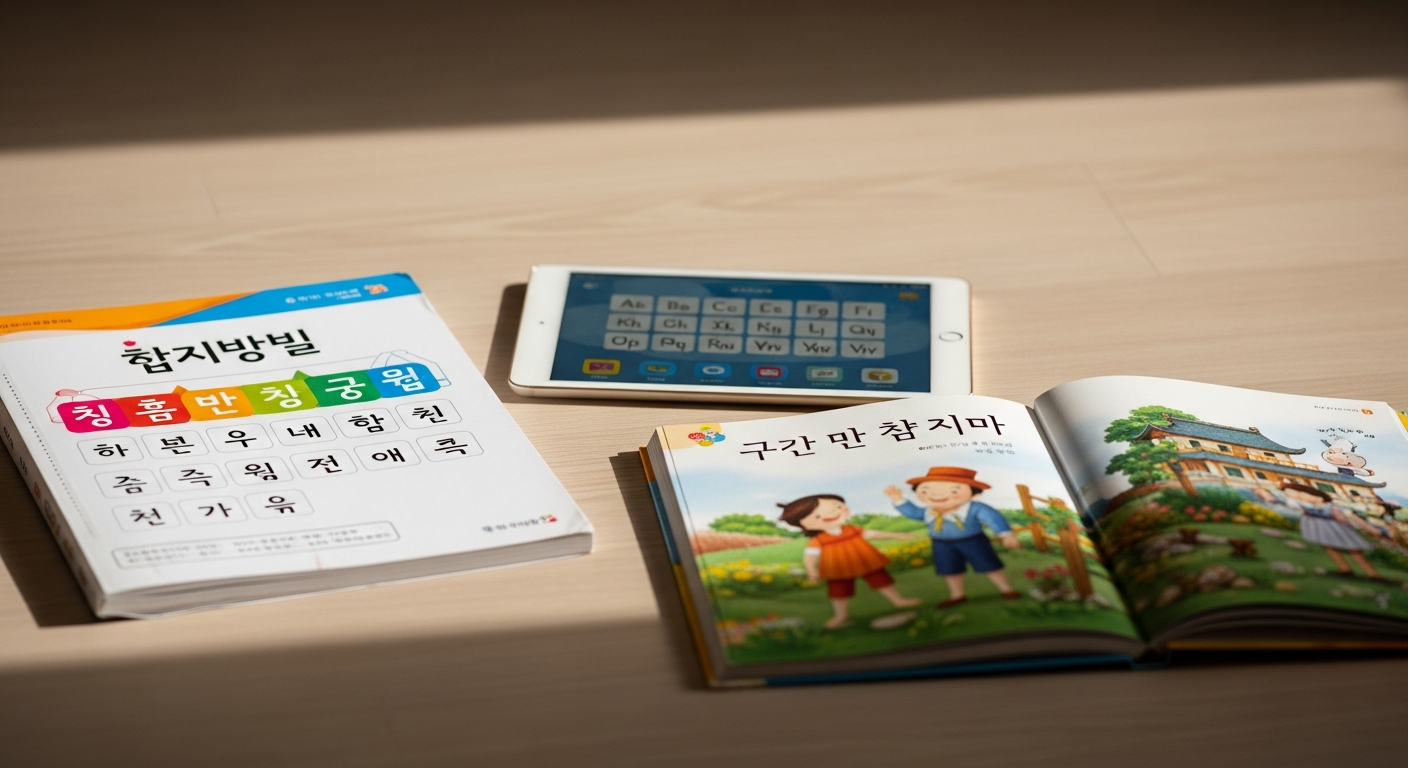
We started with a structured workbook program (let’s call it “Hangul Academy”) in the second week of February. A teacher came to our home once a week for 30 minutes, taught letters through games and activities, and left a week’s worth of worksheets. It was about $85 a month, materials included.
The first session was magical. When the teacher showed Doa the letter “ㄱ” (giyeok) and he shouted it back, eyes lighting up, I thought we’d found our answer. Thirty minutes flew by. But then reality hit. For the six days between visits, Doa was supposed to do two pages a day. By day two, he’d lost interest completely.
“Mom, how much longer do I have to do this?” became a twice-weekly question. And I became that parent—nagging him to finish before the teacher’s next visit. By week three, I’d stopped even pulling out the worksheets. Instead, I’d have him do four pages the night before the teacher came. He’d cry. I’d feel defeated.
The upside was undeniable: during that 30-minute window, Doa focused completely. The teacher corrected his pronunciation on the spot. And honestly, I loved not being responsible for teaching him myself. But the weekly deadline hanging over both our heads? That stress wasn’t worth it.
Apps — Addictive at first, but the screen time guilt was real

First week of March, I paused the workbook and downloaded “Hangul Stars” (another stand-in name). It was about $10 a month. A cheerful character teaches each letter, then reinforces it with mini-games. Doa’s response was immediate: “Can we do this again tomorrow?”
But I hit a wall fast. Our family is pretty protective about screen time—no tablets except the occasional movie night on weekends. And yet here I was, about to introduce daily hangul app time. I set a 15-minute timer at first. Doa asked for “just five more minutes” at least three times a day.
By week two, I split it: 10 minutes before preschool, 10 minutes after pickup. Suddenly Doa started asking for his “hangul game time” unprompted. Completely different from the workbook phase. The app characters celebrated his answers with stars and sparkles. He was clearly getting a hit of validation each session.
But by month two, cracks showed. Apps are great for listening and repeating, sure. But there’s almost no actual writing practice. Yes, you can trace letters on screen with your finger—but it’s nothing like gripping a pencil on paper. And around week three, Doa said, “Mom, I already did all of this.” The content for his age level? Maybe a month’s worth.
| Factor | Workbook | App | Picture Books |
|---|---|---|---|
| Monthly cost | ~$85 | ~$10 | ~$12/book (3–4 per month) |
| Child’s enthusiasm | Only when teacher visits | High for 2 weeks | Consistent all 3 months |
| Parent involvement | Nagging about homework | Managing screen time | Reading together, ~20 min |
| Writing practice | Yes, built in | Minimal | Separate practice book needed |
| Screen time | None | 20 minutes daily | None |
광고
Picture Books — Slow, but the one he asks for every single morning

Third week of March, I started with picture books. I’d deep-dived into mom blog reviews and landed on the “Hangul Adventure” series. Grabbed a 12-book boxed set from our local bookstore for about $105—roughly $9 per book. Once you buy them, they’re yours forever, so the math seemed decent.
Honestly, I was skeptical at first. No teacher showing up, no cartoon character cheering him on. Just me and Doa sitting on the couch at 8 p.m., opening one book at a time. That seemed too simple.
Then a week in, Doa asked: “Mom, aren’t we reading tonight?” Not “Do I have to do hangul now?” but “Aren’t we reading?” The difference hit me hard.
Picture books meant zero pressure to hit a certain pace. If Doa loved a particular story, we’d read it three days running. If he wasn’t feeling another one, we’d skip it. When I’d point to “ㄱ” (the letter for “giyeok”), he’d say it back, then suddenly: “Mom! That’s the sound at the start of my backpack!” He’d connect the letter to his actual life. I never saw that with the app or workbook.
“Mom, can we read this one again tomorrow? I really like it.”
By early May—three months in—Doa knew all 14 consonants and could read simple words like “backpack,” “apple,” and “tomato.” Not as fast a trajectory as the workbook or app, but here’s what mattered: every single morning, he’d ask if we were reading that night. He wasn’t being pushed. He was pulling toward it.
What I learned after three months — It’s not either/or
Each method had obvious strengths and weaknesses. Workbooks are structured but came with pressure and compliance issues. Apps are genuinely fun but limited by screen time concerns and lack of writing practice. Picture books move slowly but created zero stress and genuine daily excitement.
So here’s what we’re doing now: picture books as the daily foundation, a simple practice book from the bookstore (about $3.50) once or twice a week so Doa gets pencil-and-paper experience, and the app maybe 15 minutes on weekend car rides when boredom strikes. We paused the workbook. We’ll revisit it when he’s 6, maybe.
One mom friend summed it up perfectly: “At 4 years old, the goal isn’t mastering hangul. It’s falling in love with reading.” That landed for me. When Doa shouts “Mom, that’s a ‘gah’!” with genuine delight, that’s the real win. Not how fast he’s progressing.
Common questions
Q. Should I be doing all three?

광고
DCT Family Guide · Laurent’s Mom · Last updated 2026-05-12
Hands-on reviews from a Korean mother of two.
Personal experience-based. Product, policy, and price details may change over time — verify with the source before purchase.
💬 Frequently Asked Questions
❓ What age is best to start teaching hangul to kids?
There’s no magic number, but many Korean parents start noticing readiness around 4-5 years old when kids begin recognizing patterns or sounding out words naturally. The author’s son was 5 when he started showing interest by sounding out his friend’s name at preschool, which became the natural starting point rather than forcing it earlier.
❓ How much does a typical hangul workbook program with a visiting teacher cost?
The author paid about $85 per month for a program that included weekly 30-minute home visits plus all materials and worksheets. Keep in mind that teacher quality can vary significantly even within the same company, so it’s worth doing at least two trial sessions before committing to a monthly subscription.
❓ Do hangul learning apps actually teach kids to write, or just recognize letters?
Most apps focus heavily on listening and repeating, which is great for recognition, but they typically lack real writing practice. The author found that while her son loved the gamified format and asked to use the app daily, it didn’t provide the hands-on writing skills that workbooks or physical books offered.
❓ Can you really teach hangul without adding daily screen time?
Yes—the author tested workbooks and picture books as screen-free alternatives, though both came with their own challenges. If you do choose an app route, she recommends setting strict timers (she used 15 minutes total split into two sessions) and being prepared for the inevitable ‘just five more minutes’ requests that come with gamified learning.