광고
This post contains affiliate links. As an Amazon Associate, I earn from qualifying purchases. Your price is not affected. Affiliate Disclosure
광고
Advertisement
Key Takeaways
- Physical separation of work and play zones is the first step to maintaining focus (use partitions or bookcases)
- Desk placement should keep your child visible but toys out of sight for optimal productivity
- Build independent play routines during 9-11am and 2-4pm ‘deep work times’
- Achievable with under $100 budget using corner of living room or expanded balcony space
- Keep ’emergency play basket’ by your desk for unexpected situations during video calls
Tuesday, April 22nd, 3pm — I was in the middle of a video call with a client.
My 3-year-old suddenly climbed onto my lap and shouted “Mommy, I’m hungry!” That’s when I realized: working from a desk in the middle of the living room, surrounded by toys, has its limits.
That evening, I took a hard look at our home layout. In our 900-square-foot apartment without a spare room, I asked myself: how can I organize traffic flow and sight lines so both mom and child feel less exhausted?
Three years into remote work, I’ve learned that simply changing the space arrangement can give you an extra hour of focused morning time. Today, I’m sharing those lessons.

Why Space Separation Determines Your Focus
Early in my remote work journey, I thought “I can just work while watching my child.” Reality was different.
When block play happened right next to my desk, every 5 minutes brought another “Mommy, look at this!” My eyes would involuntarily follow my child’s gestures, and writing one email took 20 minutes.
Remote work productivity is affected by workspace quality, and it’s best to use a private room or area with minimal family traffic. If you don’t have a separate room, you need to create boundaries that even your child recognizes as “this is where mommy works.”
Our 900 sq ft Home: Here’s How We Split It
Without a dedicated office, we carved up the living room. It seemed daunting at first, but turned out simpler than expected.
Step 1: Block Sight Lines with a Bookcase
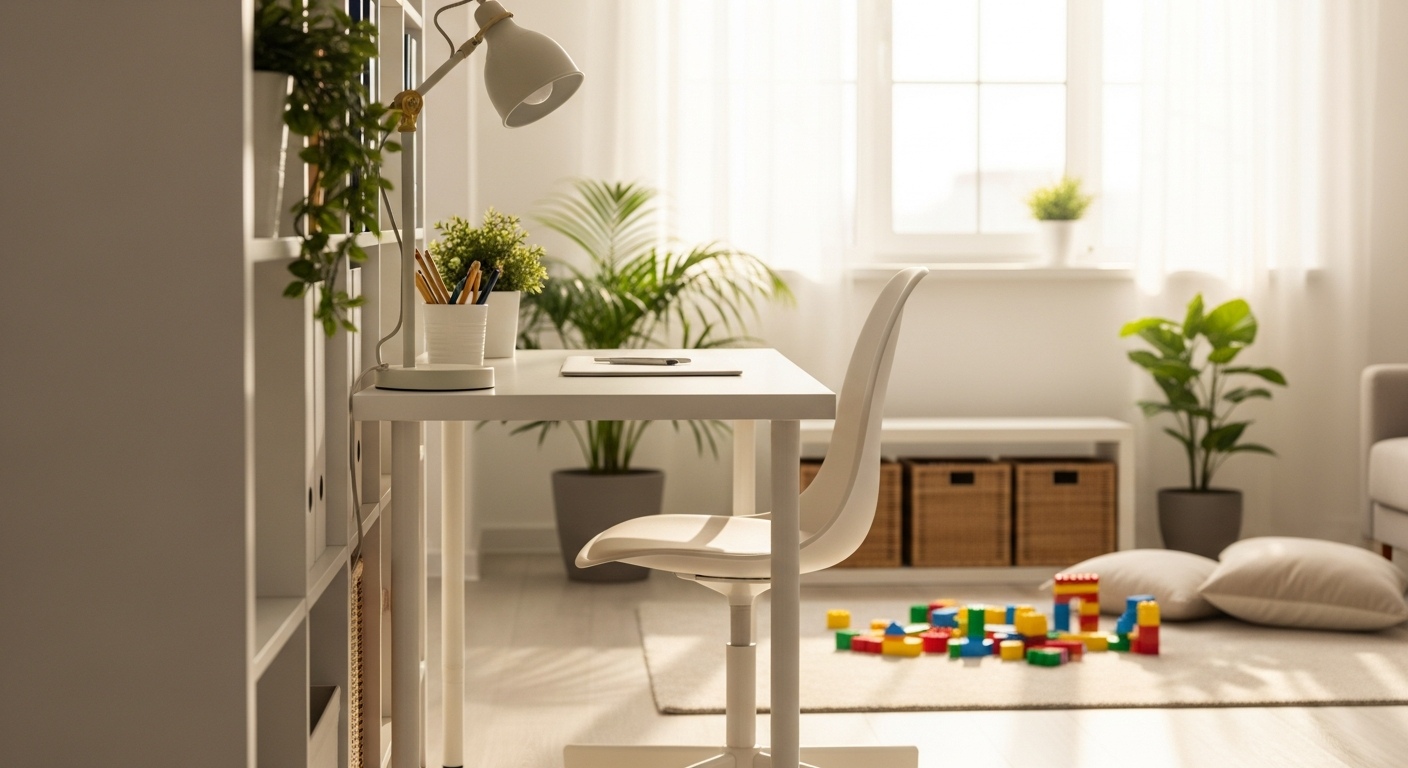
I placed an IKEA Kallax bookcase (4 feet tall) in the center of the living room. One side has my desk, the other has my child’s play mat.
From my child’s perspective, not seeing mommy reduced the “Mommy~” calls dramatically. For me, toys out of my sight line made switching to work mode much faster.
(I initially considered a clear acrylic partition, but making eye contact through it kills concentration. Opaque material was the answer.)
Step 2: Position Your Desk in ‘Command Position’
The ‘command position’ with a clear view of the door is effective for psychological stability and improved focus. When I turned my desk toward the entryway, I could anticipate when my child was coming out of the bedroom.
I placed the desk with my back to the wall and the window in front. Positioning your desk with natural light coming from the side reduces eye strain and helps maintain concentration.
Step 3: Design Play Zone for ‘Independent Play’
On the opposite side of the bookcase, the play area contains only these items:
- 5×6 foot play mat (noise reduction + boundary marker)
- Child-height toy storage (for self-serve and cleanup)
- Small book basket (only 5-6 picture books)
The key is **not having too many toys**. With just 3-4 options, my child plays independently for 30 minutes. With 20+ toys piled up, it’s “Mommy, what should I do?” every 5 minutes.

If You Have an Enclosed Balcony, This Is Gold
My friend has a 1,200 sq ft place and turned the balcony into an office. A balcony space with windows on one full side is perfect for a home office, and closing the living room side window creates complete separation from the rest of the home.
A 4-foot width is enough for a desk. IKEA custom-cuts countertops, so there’s no wasted space.
If sunlight is too strong, add a blind. In winter, one space heater keeps it warm. I’m definitely trying a balcony office at my next place.
광고
Video Call Emergency Kit
No matter how well you divide space, video calls are unpredictable. That’s why my desk drawer has an ’emergency play basket.’
- Sticker books (quiet, 15 minutes of focus)
- Magnetic fishing game (silent)
- Snacks (last resort)
Five minutes before a call starts, I say “Mommy has an important call. Can you do this while you wait?” — 70% success rate.
The other 30%? Honestly, my child just appears on camera. Clients are understanding these days. (Though I always ask for grace in advance.)
Advertisement
광고
Time-Based Routines Double Space Efficiency
Even with divided space, routines are essential. Here’s my schedule:
| Time | Child Activity | Mom’s Work | Space |
|---|---|---|---|
| 9-11am | Independent play (blocks, books) | Deep work (proposals, meetings) | Separate zones |
| 11am-12pm | Lunch prep together | Light emails | Kitchen (together) |
| 1-3pm | Nap or quiet play | Focused work | Separate zones |
| 3-5pm | Snack + walk | Wrap-up tasks | Living room or outside |
| After 5pm | Play, dinner, bath | Off duty | Shared space |
The morning 9-11am and afternoon 1-3pm slots are sacred. I turn off Slack notifications and focus only on deep work.
My child knows now: “When mommy sits at that desk, it’s quiet time.” It took about two weeks to establish this pattern.
Budget Breakdown: Under $100 Is Possible
You don’t need expensive furniture. Here’s what I actually spent:
- Used bookcase (partition): $30 (Facebook Marketplace)
- Foldable desk: $45 (Amazon)
- Play mat: $20 (Target)
- Small storage bins: $15 (Dollar store)
Total: $110
The bookcase was the biggest expense, but you can use tension rods with curtains for even less. The point is creating visual separation, not building walls.
I’ve seen moms use clothing racks, room dividers, even tall plants. Get creative with what you have.
What Didn’t Work (So You Don’t Waste Time)
Before finding this setup, I tried things that flopped:
❌ Working at the dining table
Meal prep interrupted work constantly. Plus, no psychological boundary between “work” and “home.”
❌ Rotating between rooms
Thought moving to different spots would help. Actually created chaos. My child followed me everywhere asking “Why are you moving?”
❌ Open-concept “we’re together” setup
Sounds nice in theory. In practice, constant interruptions. Neither of us could focus.
Reader Questions I Get a Lot
“What if my child cries when separated?”
Start with 10-minute intervals. Stay in sight but set the boundary. Gradually extend the time. Also, separation happens naturally when they’re engaged — hence the limited toy selection.
“Does this work with two kids?”
My friend has a 3-year-old and 5-year-old. She created two play zones (one for each) on opposite sides of her work area. They check in with each other less when separated, surprisingly.
“What about noise?”
Noise-canceling headphones during calls. For focused work, I use brown noise on low volume. And honestly? I’ve learned to work with background kid sounds. It’s not silent, but it’s functional.
The Real Game-Changer? Letting Go of Perfection
Year one, I stressed about having a Pinterest-perfect office. Year three? My desk has crayon marks, and there’s usually a stuffed animal in my Zoom background.
The space doesn’t have to be beautiful. It has to work.
These five changes — physical partition, strategic desk placement, minimal play zone, time routines, and emergency backup plans — gave me back my sanity.
They won’t eliminate all interruptions. But they’ll reduce them by 60-70%, which in the world of parenting and remote work? That’s a win.
If you’re reading this at your kitchen table while your toddler dumps blocks on your laptop, I see you. It gets better with small, intentional changes.
Start with one bookcase. See what happens.
광고

광고
DCT Family Guide · Laurent’s Mom · Last updated 2026-04-29
Hands-on reviews from a Korean mother of two.
Personal experience-based. Product, policy, and price details may change over time — verify with the source before purchase.
💬 Frequently Asked Questions
❓ What if my toddler can still hear me on work calls even with a bookcase divider?
Sound will still travel, so the bookcase mainly helps with visual separation, not noise blocking. For important calls, consider using a white noise machine on the play side or scheduling calls during nap time or when another caregiver can take your child to another room.
❓ How do I keep my toddler from just walking around the bookcase to get to me?
The barrier works best when paired with established routines—your child learns that when you’re on ‘that side,’ it’s work time. The ’emergency play basket’ mentioned in the post helps too; keep high-interest toys there that only come out during urgent work moments to buy yourself 10-15 minutes.
❓ Is a 4-foot Kallax bookcase really tall enough to block a toddler’s view?
For most toddlers ages 2-4, yes—the average 3-year-old is about 3 feet tall, so a 4-foot bookcase blocks direct eye contact when they’re playing on the floor. If your child is taller or frequently stands, you might need a 5-6 foot shelving unit instead.
❓ What do you put in the ’emergency play basket’ that actually keeps a toddler busy?
Rotate novel items they don’t see often: a special set of stickers, pipe cleaners for threading, a small container of water beads, or a ‘new’ toy from your stash. The key is novelty—items they play with daily won’t hold their attention when you need it most.